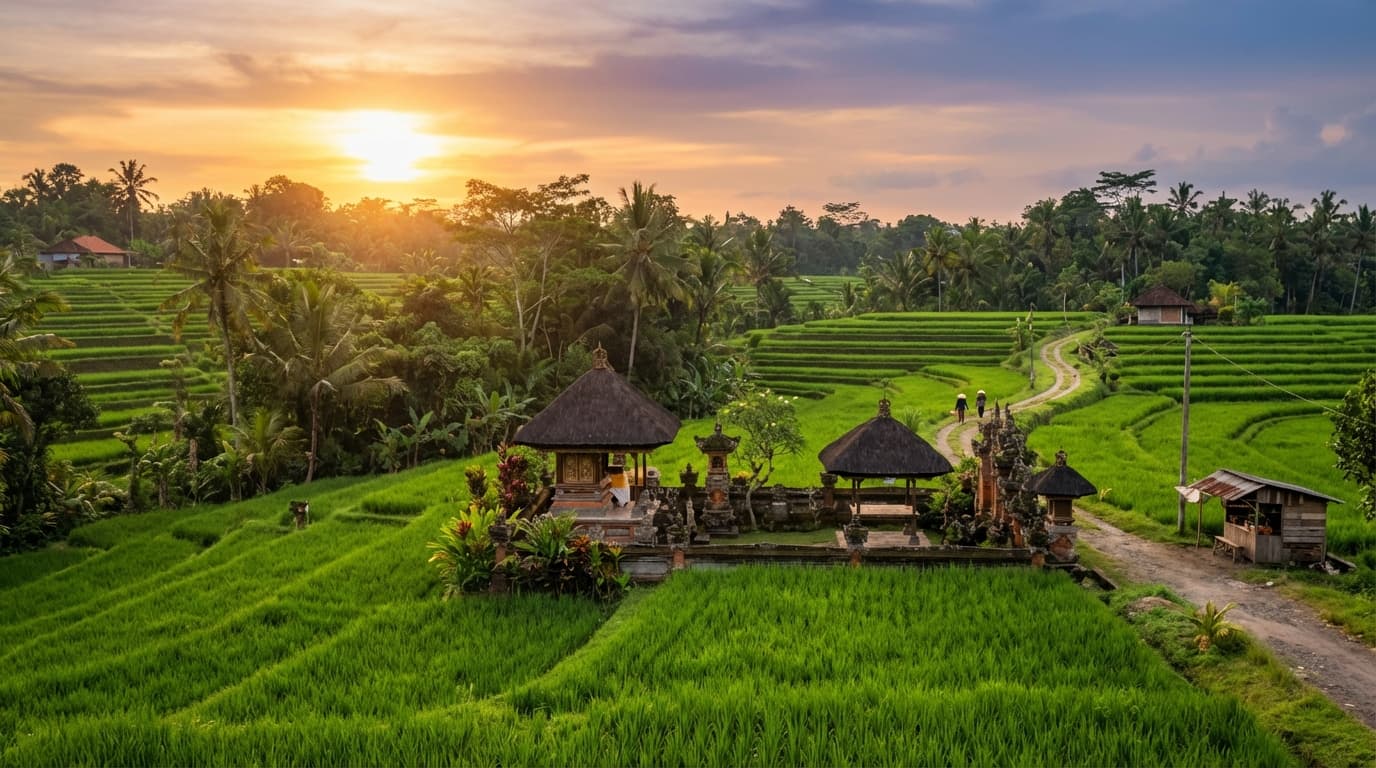
Bali Rice Terraces: Tegallalang, Jatiluwih or Sidemen?
Bali’s rice terraces are working agricultural and cultural landscapes, not permanent green stage sets. Fields are planted, irrigated and harvested on different schedules. Paths may cross private or community land, and ceremonies or farm work can change access.
The strongest choice is therefore not “Which terrace looks best on Instagram?” It is: which landscape fits your base, walking time and interest in the subak system?
DFS research in August 2026 shows about 1,600 monthly searches for the broad Bali rice-terrace cluster, roughly 3,600 for major Tegallalang variants and about 1,900 for Jatiluwih. This page owns the comparison. Individual destination pages handle the surrounding stay and route.
Bali rice terraces at a glance
| Landscape | Best fit | Main trade-off |
|---|---|---|
| Tegallalang | A famous, shorter terrace visit from Ubud | Crowds, commercial additions and fragmented access expectations |
| Jatiluwih | A large landscape, longer walk and subak context | More transport time; deserves to anchor the day |
| Sidemen | A slower valley stay with fields woven into daily scenery | Not one single managed “terrace attraction” |
| Pupuan / Belimbing direction | A quieter west-Bali landscape route | Longer logistics and less simple visitor infrastructure |
Choose one major landscape. Combining Tegallalang, Jatiluwih and Sidemen in one day would turn different regions into windshield scenery.
Understand the subak before choosing a photo
UNESCO’s Cultural Landscape of Bali Province recognises a system shaped by water temples, canals, rice fields and cooperative management. The subak is not simply a terrace-building technique. It connects water sharing, religious practice and community organisation.
That context changes visitor behaviour:
- stay on permitted visitor routes;
- do not step into planted fields for a photograph;
- ask before photographing people at work;
- follow instructions around temples and ceremonies;
- use official access and current local contribution systems;
- take litter out and avoid blocking narrow farm paths.
Bali’s visitor code requires respectful behaviour at sacred places and compliance with local rules. A paid entrance or tour does not create permission to ignore a farmer, ceremony or restricted path.
Tegallalang: the convenient Ubud choice
Tegallalang is the practical option for travellers based in or near Ubud who want a recognisable terrace landscape without devoting an entire day to the transfer. That convenience is also the main source of pressure: popular viewpoints, swings, cafes and multiple access points can make the experience feel more commercial than expected.
Choose Tegallalang when:
- you have limited time in central Bali;
- a shorter terrace walk fits the group;
- it can be visited early or as part of one nearby route;
- you accept that the wider area includes commercial experiences.
Do not assume every sign, path or platform belongs to one unified attraction. Check the current official entrance, selected walking route, parking and any separate activity terms before committing.
A stronger Tegallalang plan
Arrive with one purpose: landscape walk, cultural context or a commercial swing/photo experience. Those are different products. Complete the chosen route, eat nearby if it fits, then continue to one nearby cultural stop or return to Ubud.
Avoid stacking Tegallalang with several waterfalls, Mount Batur and a distant sunset. Use the Bali day-trip guide to keep the corridor realistic.
Jatiluwih: the landscape that deserves the day
Jatiluwih is the stronger choice when the rice landscape itself is the main experience. The scale supports longer observation and walking, while its relationship to the UNESCO cultural landscape gives the visit more context than a quick viewpoint.
Choose Jatiluwih when:
- you want a wider agricultural landscape;
- the group has time for a deliberate walking route;
- a longer drive from the south or Ubud is acceptable;
- you are willing to make it the anchor rather than an add-on.
The exact colour and crop stage cannot be promised. A harvested or newly planted field is not a failed visit; it is evidence that the landscape is alive.
Plan the walking route first
Check the current route options, surfaces, length, weather and return time at the official entrance. Heat and rain change the effort. Carry water and sun or rain protection, and do not shortcut across fields.
If Jatiluwih requires too much transfer from the current hotel, consider moving north/central for a night or choosing Tegallalang instead. The better landscape on paper can be the worse day in practice.
Sidemen: choose a stay, not a ticket window
Sidemen is different because the appeal is the wider valley routine: fields, villages, Mount Agung views when conditions allow, and a slower base. It is not one single rice-terrace attraction with a universal path.
Choose Sidemen when:
- the trip benefits from a quieter overnight base;
- you want a guided village or field walk with local context;
- rice landscapes should be part of several mornings rather than one stop;
- East Bali is already in the route.
Use the Sidemen destination owner before booking a day trip from the far south. A stay often produces a more coherent experience than a long return drive.
Ask the accommodation or guide which paths are currently appropriate. A map pin or social post is not permission to enter private land.
Pupuan and Belimbing: for a west-Bali route
West-Bali terrace landscapes suit travellers already moving through that region or intentionally seeking a quieter route. They are not an efficient detour from Uluwatu, Nusa Dua or Canggu merely to avoid Tegallalang crowds.
Choose this direction when the journey includes west or north Bali and the landscape can be integrated without doubling back. Clarify road access, walking and local guiding before departure.
Compare by experience, not ranking
For the first Bali trip
Choose Tegallalang when staying in Ubud and time is limited. Choose Jatiluwih when the cultural landscape and walking are a priority worth a separate day.
For photographers
Choose access and light ethically. Do not enter fields, direct workers or fly a drone without current permission. A compact camera setup and respectful distance are stronger than staging a scene.
For families or limited mobility
Do not rely on the word “viewpoint”. Check steps, slopes, path width, shade, seating and toilet access for the exact entrance and route. A cafe view may fit better than a full terrace walk.
For a quieter trip
Stay in Sidemen or integrate a west-Bali landscape into an existing route. “Hidden” does not mean visitor-ready or public.
Current-total and access check
Old guides often publish one fixed entrance fee. That creates false confidence because parking, walking routes, commercial activities, local contributions and guide services may be separate.
Verify:
| Detail | Question |
|---|---|
| Entrance | Is this the official access for the selected route? |
| Walking | What is the current surface, distance and weather exposure? |
| Extras | Are swings, platforms, guide or parking separate products? |
| Permission | Which paths are public or approved for visitors? |
| Timing | Does the route fit transport and daylight without rushing? |
| Terms | What changes if weather, ceremony or farm work affects access? |
Compare the complete current visit, not an old entrance figure.
What to bring
Bring water, sun and rain protection, footwear with suitable grip, a modest layer for any temple context and a charged phone. Pack lightly and keep hands free on narrow or uneven paths.
No specialist Amazon product is needed for this page. Use the camera, bottle, hat and small bag you already own when they fit the route.
The verdict
Choose Tegallalang for a shorter, famous terrace visit from Ubud. Choose Jatiluwih for a larger landscape and a day built around walking and subak context. Choose Sidemen when the rice landscape should shape the stay rather than fill one sightseeing slot.
Whichever wins, visit it as a living landscape: stay on the right path, respect work and ceremony, and let the current season be part of the experience.
Frequently Asked Questions
What are the best rice terraces in Bali?
Tegallalang fits a short, famous terrace visit near Ubud; Jatiluwih fits a larger landscape and longer walking day; Sidemen fits a slower valley stay where fields are part of the wider place. The best choice depends on base, time, walking and desired context.
Is Tegallalang or Jatiluwih better?
Choose Tegallalang for proximity to Ubud and a shorter visit. Choose Jatiluwih for a broader agricultural landscape and more deliberate route. Jatiluwih requires more travel from south Bali, while Tegallalang can be busier and more commercial.
Are Bali rice terraces green all year?
No specific field appearance is guaranteed. Planting and harvest stages vary by plot and local decisions, so neighbouring terraces can look different on the same day. Visit for the living landscape rather than a promised shade of green.
Are the Bali rice terraces free to visit?
Access, parking, route charges and local contribution practices can change. Use the official entrance where one exists and check the current complete total locally. Do not enter working fields or private paths without permission.
How long do I need at Jatiluwih rice terraces?
Allow enough time for the selected walking route, weather, breaks and transport. Jatiluwih is better treated as the anchor of a day than as a quick photo stop squeezed between distant attractions.
Can I fly a drone over Bali rice terraces?
Do not assume drone use is permitted. Airspace, site, privacy, ceremony and local rules apply, and requirements can change. Verify current official rules and obtain site or landholder permission where required.
Sources & References

Go2Bali Team
Travel Writer at Go2Bali
- ●Bali travel experts
- ●Locally verified information
- ●Regular content updates
The Go2Bali team shares local insights, practical travel tips, and in-depth guides to help you explore Bali like a seasoned traveler.
More about usPlan Your Bali Trip
Book hotels, tours, and transport through our trusted partners and get the best deals for your Bali adventure.
Affiliate links: we may earn a commission at no extra cost to you. Prices and availability are set by each provider.