Welkom op Bali — laat je inspireren en plan jouw droomreis.
Sate Lilit

BALINESE FOOD GUIDE

Sate Lilit

Balinese Satay

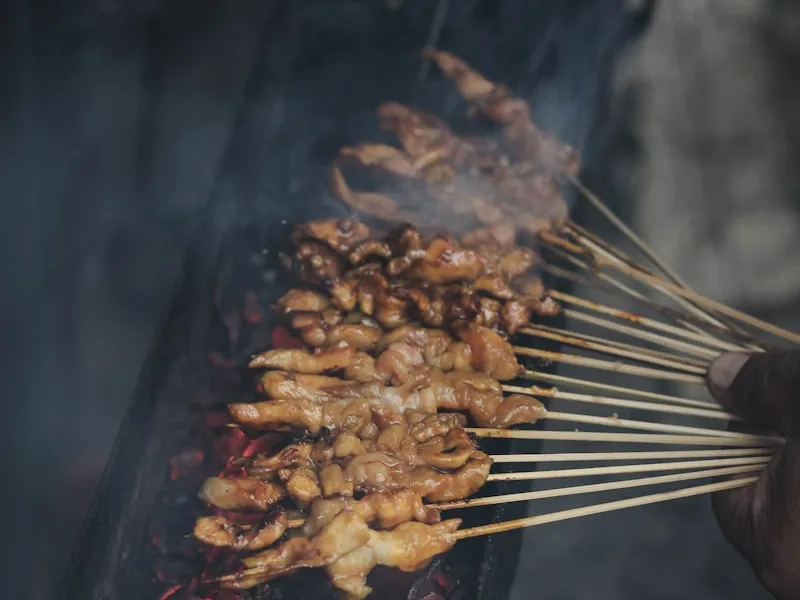
Bali's signature satay — unlike regular skewered satay found elsewhere in Indonesia, sate lilit features a seasoned paste of minced fish (or chicken, pork, or turtle), grated coconut, coconut milk, lime leaves, and lemongrass, hand-wrapped around lemongrass sticks or bamboo skewers and grilled over coconut husks. The result is moist, fragrant, and subtly sweet with the aromatics infusing directly into the meat from the lemongrass handle.

Nederlandse versie in redactie. Deze pagina blijft buiten Google totdat de tekst als zelfstandige Nederlandse gids is bewerkt.

Spice level

Mild

Cooking difficulty

Moderate

Preparation

45 minutes

Where it belongs

Central Bali

TASTE & CONTEXT

What makes Sate Lilit distinctive?

What distinguishes sate lilit from every other satay in Indonesia is the technique captured in its name: lilit means 'to wrap' in Balinese. Rather than threading chunks of meat onto a skewer, the cook creates a smooth, dense paste from finely minced or ground protein — most traditionally fish, but also chicken, pork, or prawn — blended with grated coconut, coconut milk, lime leaves, lemongrass, shallots, garlic, turmeric, galangal, and a measured amount of chili. This paste is then pressed firmly around the skewer in a spiral motion, working from the base upward until the stick is encased in an elongated cylinder of seasoned meat mixture. The skewers are characteristically Balinese: thick lemongrass stalks (serai) are the most traditional choice, meaning the heat of grilling opens the lemongrass and infuses its citrus-floral oils directly into the meat from the inside. Bamboo skewers and palm ribs (lidi aren) are also used. The wrapped satay is grilled over charcoal or coconut husks, turned regularly until the exterior develops a golden crust while the interior remains moist and yielding. Sate lilit is almost always made with ikan (fish) in coastal areas — the texture of white-fleshed fish like tuna, mackerel, or Spanish mackerel holds the paste together perfectly. Inland, chicken or pork versions are more common. It is served without peanut sauce — that is a Javanese addition — instead paired with sambal matah, steamed rice, and occasionally a simple plecing kangkung (water spinach with chili).

IN THE KITCHEN

How it is traditionally made

Fresh fish (or alternative protein) is minced very finely or blended to a smooth paste in a cobek stone mortar or food processor. Grated young coconut, coconut milk, kaffir lime leaves (daun jeruk), lemongrass (serai), shallots, garlic, turmeric, galangal, and bird's eye chili are ground together to form a base genep-style spice paste and folded thoroughly into the meat. The mixture is pressed firmly around lemongrass stalks or bamboo skewers in a spiral, compressing tightly so it does not fall off during grilling. Skewers are grilled over hot charcoal or coconut husks, turned continuously, for approximately 8-12 minutes until cooked through with light char marks on the surface.

TRY IT IN BALI

Where and how to order

Warung Sate Lilit Men Wayan in Sanur, Biku Restaurant in Seminyak for an upscale version, or the many food stalls at Sindhu Night Market in Sanur. Also widely available at traditional markets across Gianyar regency.

Sate lilit is considered uniquely Balinese and distinct from the peanut-sauce satay common across Java and mainland Southeast Asia. The 'lilit' technique (meaning 'to wrap') is a traditional method passed down through generations, and the dish frequently appears at temple ceremonies and family gatherings. In coastal areas, it is typically made with fresh-caught fish, while inland villages prefer chicken or pork.

Explore the Bali street-food guide

VARIATIONS

Why two plates may differ

Coastal Balinese (fish): Uses fresh tuna, mackerel, or white-fleshed fish — the most traditional version, common in Sanur, Jimbaran, and coastal villages of Buleleng.
Inland/central Bali (chicken): Minced chicken with higher coconut content gives a slightly sweeter, more yielding texture — widely served in Ubud and Gianyar warungs.
Ceremonial pork version: Uses minced pork or mixed pork offal in the spice paste for temple ceremonies — less commonly sold commercially but found at Galungan celebrations.
Modern restaurant variation: Prawn sate lilit wrapped around sugarcane skewers, served at upscale restaurants in Seminyak and Ubud with mango sambal.