Ubud vs Canggu: Which Bali Area Is Right for You?
Introduction
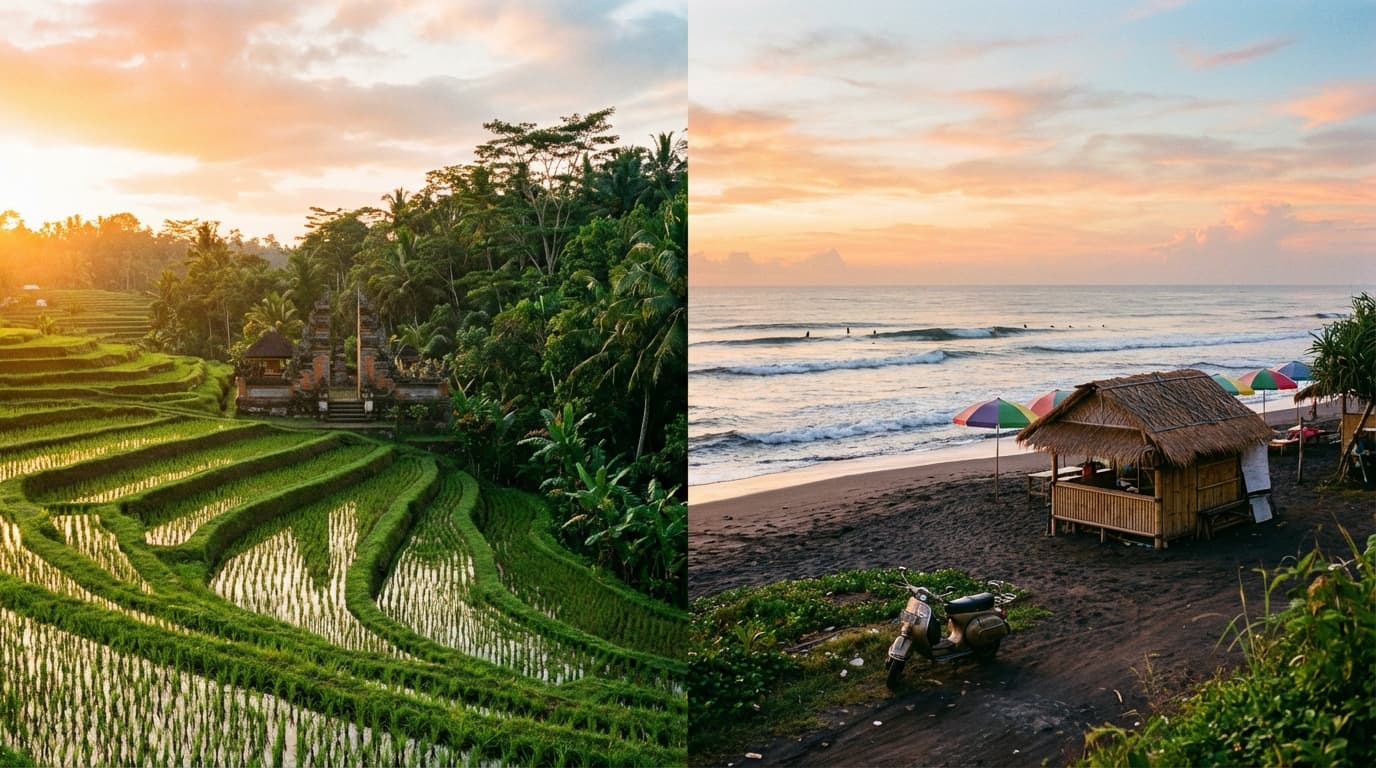
The "Ubud vs Canggu" debate is one of the most common dilemmas facing Bali travelers. These two areas represent fundamentally different sides of the island's personality, and choosing between them (or deciding to split your time) shapes your entire Bali experience. Ubud is the cultural, spiritual heart of Bali: think rice terraces, ancient temples, yoga studios, and jungle-set villas. Canggu is the modern, social, surf-culture epicenter: think beach clubs, trendy cafes, co-working spaces, and sunset cocktails.
Neither is objectively "better." The right choice depends entirely on what you want from your Bali trip. This guide compares the two areas across every dimension that matters: atmosphere, accommodation, food, activities, costs, nightlife, transportation, and practical considerations. By the end, you will know exactly which area suits you, or whether splitting your time between both is the smartest move.
The Vibe
Ubud's Atmosphere
Ubud feels like stepping into the Bali of travel documentaries and spiritual memoirs. The town sits in the central highlands, surrounded by rice terraces, deep river valleys, and dense tropical forest. Monkeys swing through the trees, gamelan music drifts from temple ceremonies, and the air is noticeably cooler and fresher than the coast.
The cultural density is remarkable. Within walking distance of the town center, you will find the Sacred Monkey Forest, the Ubud Royal Palace, several significant temples, traditional dance performances every evening, and an art market selling handcrafted goods. The streets are lined with yoga studios, organic cafes, galleries, and healers' practices.
Ubud attracts: solo travelers on spiritual journeys, couples seeking romance, yogis and wellness enthusiasts, artists and writers, and anyone wanting an immersive cultural experience. The crowd tends to be slightly older and more introspective than Canggu's.
The downside: Ubud's popularity means the town center can feel crowded and commercialized, especially along Jalan Raya Ubud and around the Monkey Forest. Traffic in the center is genuinely bad. The real magic of Ubud is found 10-15 minutes outside the center, in areas like Tegallalang, Penestanan, Keliki, and Campuhan.
Canggu's Atmosphere
Canggu (pronounced "chan-goo") is coastal Bali's hippest neighborhood, a sprawling area of rice paddies, surf breaks, and narrow lanes packed with cafes, boutiques, and co-working spaces. The vibe is young, international, and energetic. On any given morning, the beach is lined with surfers, the cafes are full of laptop workers, and the Instagram-ready brunch spots have queues out the door.
Canggu is not one place but a collection of neighborhoods: Batu Bolong (the main strip, walkable to the beach), Berawa (slightly more upscale, great restaurants), Pererenan (quieter, rice paddy views), and Echo Beach (rawer, surf-focused). The area has grown explosively in recent years, bringing both exciting development and growing pains like traffic and construction noise.
Canggu attracts: digital nomads, surfers, young couples, social travelers, fitness enthusiasts, and anyone who wants a beach-centric lifestyle with modern amenities. The crowd skews younger (20s-30s) and more international.
The downside: Canggu can feel like an international bubble where Balinese culture takes a back seat to Australian brunch culture and global party vibes. Traffic congestion is severe, especially on the main roads around Batu Bolong. Development is rapid and sometimes chaotic.
Accommodation Compared
Ubud Accommodation
Ubud's accommodation strength is character and setting. Properties here are surrounded by nature: jungle, rice terraces, river valleys. Even budget options often feature traditional Balinese architecture and garden settings.
| Type | Price Range (per night) | What to Expect |
|---|---|---|
| Dorm bed | IDR 100,000-200,000 ($6-13) | Basic but clean, often with pool access |
| Budget guesthouse | IDR 200,000-500,000 ($13-32) | Private room, breakfast, garden setting |
| Mid-range villa | IDR 500,000-1,500,000 ($32-96) | Private pool, rice field or jungle views |
| Luxury resort | IDR 2,500,000-10,000,000 ($160-640) | World-class facilities, valley views, spa |
Canggu Accommodation
Canggu's accommodation is generally more modern and Instagram-ready. Sleek minimalist villas, trendy hostels with rooftop pools, and beach-adjacent apartments dominate the landscape.
| Type | Price Range (per night) | What to Expect |
|---|---|---|
| Dorm bed | IDR 120,000-250,000 ($8-16) | Social hostels, pool parties, events |
| Budget guesthouse | IDR 300,000-600,000 ($19-38) | Private room, pool, close to cafes |
| Mid-range villa | IDR 800,000-2,000,000 ($51-128) | Private pool, modern design, walk to beach |
| Luxury villa | IDR 2,500,000-8,000,000 ($160-512) | Beachfront or rice field views, full staff |
Verdict: Ubud offers better value and more character. Canggu offers more convenience and beach proximity. For monthly rentals, Ubud is 20-30% cheaper.
Food Scene
Eating in Ubud
Ubud's food scene is extraordinary and diverse:
- Local warungs: Authentic Balinese food at unbeatable prices. Nasi campur for IDR 25,000-35,000 ($1.60-2.25). Try Warung Biah Biah or Nasi Ayam Kedewatan Bu Mangku.
- Health food and vegan: Ubud is arguably Southeast Asia's best vegan food destination. Places like Sage, Alchemy, and Seeds of Life serve creative plant-based meals for IDR 60,000-120,000 ($4-8).
- Fine dining: Locavore (repeatedly named Indonesia's best restaurant), Mozaic, and Room4Dessert offer world-class tasting menus for IDR 800,000-1,500,000 ($51-96) per person.
- Cafes: Excellent coffee culture with spots like Seniman Coffee Studio, Anomali Coffee, and Mudra Cafe.
Eating in Canggu
Canggu's food scene is international and trendy:
- Local warungs: Available but harder to find among the trendy cafes. Warung Dandelion and Warung Bu Mi offer local meals for IDR 30,000-50,000 ($2-3.20).
- Brunch culture: Canggu is Bali's brunch capital. Smoothie bowls, avocado toast, and eggs Benedict dominate at places like Crate Cafe, Milk & Madu, and Bali Bowl. Expect IDR 70,000-120,000 ($4.50-8) for brunch.
- International cuisine: Excellent Mexican (Motel Mexicola popup), Italian (La Baracca), Japanese (Sushi Yabi), and Australian-influenced restaurants abound.
- Beach clubs: Finns Beach Club, The Lawn, and La Brisa offer upscale beachfront dining with cocktails and DJs. Main courses IDR 120,000-250,000 ($8-16).
Verdict: Ubud wins for authentic Balinese food, health food, and fine dining. Canggu wins for international variety, brunch culture, and beachside dining.
Activities and Things to Do
Ubud Activities
- Rice terrace walks: Tegallalang, Campuhan Ridge Walk, and the lesser-known Keliki terraces
- Temple visits: Tirta Empul, Goa Gajah, Gunung Kawi
- Yoga: The Yoga Barn, Radiantly Alive, Intuitive Flow (drop-in classes IDR 130,000-200,000 / $8-13)
- Monkey Forest: Sacred Monkey Forest Sanctuary (IDR 80,000 / $5 entry)
- Art and culture: ARMA Museum, Blanco Renaissance Museum, nightly traditional dance performances (IDR 100,000 / $6)
- Cooking classes: Multiple operators offering Balinese cooking instruction
- Rafting: White water rafting on the Ayung River (IDR 350,000-500,000 / $22-32)
- Cycling: Guided downhill cycling tours through rice paddies and villages
Canggu Activities
- Surfing: Batu Bolong, Old Man's, Echo Beach, Berawa (lessons IDR 350,000-500,000 / $22-32)
- Beach clubs: Finns, The Lawn, La Brisa, Ulu Cliffhouse (nearby)
- Fitness: CrossFit, boxing, calisthenics parks, beach running
- Yoga: Desa Seni, The Practice, Serenity Eco Guesthouse
- Skateboarding and BMX: Several skate parks including Vans-sponsored facilities
- Night markets: Batu Bolong night market on Saturday evenings
- Boutique shopping: Independent clothing, jewelry, and homewares shops
- Day trips: Easy access to Tanah Lot temple (20 minutes)
Verdict: Ubud wins for cultural activities and nature. Canggu wins for surfing, beach life, and fitness.
Nightlife
Ubud After Dark
Ubud is not a nightlife destination. Evenings tend to be mellow:
- Traditional dance performances at the Palace or Arma Open Stage (7:00-8:30 PM)
- Cocktail bars like Night Rooster and CP Lounge
- Live music at Jazz Cafe Ubud
- Most places wind down by 11 PM
Canggu After Dark
Canggu has a vibrant, growing nightlife scene:
- Old Man's: The legendary surf bar with cheap Bintang, pool tables, and legendary Wednesday reggae nights
- Deus Ex Machina: Motorcycles, craft cocktails, and live music
- Finns Beach Club: Massive beachfront venue with DJs, events, and late-night parties
- Pretty Poison: Dive bar vibes with punk rock and skateboarding culture
- Gimme Shelter: Late-night bar with a rock-and-roll attitude
- Things often continue until 2-3 AM on weekends
Verdict: Canggu wins decisively for nightlife. Ubud is not the place for partying.
Transportation and Getting Around
Getting Around Ubud
- Walking: The town center is walkable, but most accommodations and attractions require transport
- Scooter: Essential for exploring the wider Ubud area. Rental IDR 70,000-100,000 ($4.50-6.40) per day. Roads are narrower and hillier than the coast
- Private driver: Half-day IDR 300,000-400,000 ($19-26). Full day IDR 500,000-700,000 ($32-45)
- Grab/Gojek: Available but with limited coverage outside the center. Drivers sometimes refuse pickups from remote villas
Getting Around Canggu
- Scooter: The primary transport mode. Rental IDR 70,000-100,000 ($4.50-6.40) per day. Traffic is heavy, especially on Jalan Batu Bolong and Jalan Pantai Berawa during peak hours
- Grab/Gojek: Widely available and reliable throughout Canggu
- Walking: Possible within neighborhoods (Batu Bolong is walkable to the beach) but not between them
- Bicycle: Growing cycling infrastructure, though traffic makes it stressful on main roads
Verdict: Both areas require a scooter for full exploration. Canggu has better ride-hailing coverage. Ubud's center is more walkable.
The Split Stay: Best of Both Worlds
For trips of 7 days or longer, we strongly recommend splitting your time between both areas. Here is how to structure it:
Recommended Split Stay Itinerary (10 days)
Days 1-4: Ubud
- Settle in, adjust to Bali time
- Rice terrace walks and temple visits
- Cooking class and yoga
- Fine dining and cultural performances
- Day trip to Mount Batur or waterfall
Day 5: Transfer Day
- Morning activity in Ubud
- Afternoon transfer to Canggu (1 hour by car)
- Sunset at the beach
Days 5-9: Canggu
- Surf lessons or beach days
- Beach club afternoons
- Explore the food scene
- Day trip to Tanah Lot temple
- Nightlife and social scene
Day 10: Departure
- Final morning surf or brunch
- Transfer to airport (45 minutes from Canggu)
This structure works because Ubud is better for arriving and adjusting (the cooler climate and calmer atmosphere ease jet lag), while Canggu is better for the second half when you are settled and ready for more social, active experiences.
Quick Decision Guide
| If you want... | Choose... |
|---|---|
| Temples and rice terraces | Ubud |
| Surfing and beaches | Canggu |
| Yoga and wellness | Ubud |
| Nightlife and parties | Canggu |
| Budget accommodation | Ubud |
| Digital nomad community | Canggu |
| Fine dining | Ubud |
| Brunch culture | Canggu |
| Quiet, romantic escape | Ubud |
| Fitness and sports | Canggu |
| Traditional Balinese culture | Ubud |
| International social scene | Canggu |
| Both? | Split your stay! |
Final Thoughts
Ubud and Canggu are both excellent bases in Bali, but they cater to fundamentally different travel styles. Ubud offers the cultural depth, natural beauty, and spiritual atmosphere that made Bali famous. Canggu offers the modern, social, surf-focused lifestyle that has made Bali a global destination for young travelers and digital nomads. There is no wrong choice, only the choice that matches what you want from your time on the island.
If you have the time, split your stay and experience both. If you must choose one, ask yourself: do I want my mornings to start with a rice terrace sunrise or a surf session? That answer will tell you exactly where to go.
Frequently Asked Questions
Is Ubud or Canggu better for first-time Bali visitors?
For first-timers wanting the classic Bali experience with temples, rice terraces, and cultural immersion, Ubud is the better choice. If you prioritize beach access, surfing, and a lively social scene, Canggu wins. Many first-timers split their trip: 3-4 days in Ubud, then 3-4 days in Canggu, which gives you the best of both worlds.
Which is cheaper, Ubud or Canggu?
Ubud is generally 20-30% cheaper than Canggu for accommodation, food, and activities. A mid-range villa in Ubud costs IDR 4,000,000-7,000,000 ($256-450 USD) per month vs. IDR 6,000,000-12,000,000 ($385-770 USD) in Canggu. Local warung meals in Ubud average IDR 25,000-35,000 ($1.60-2.25) vs. IDR 35,000-50,000 ($2.25-3.20) in Canggu. Western-style restaurant meals are similarly priced in both areas.
How far apart are Ubud and Canggu?
Ubud and Canggu are approximately 25-35 km apart, depending on your exact route. By car or scooter, the drive takes 45-90 minutes depending on traffic. The route passes through beautiful rice paddy scenery. Grab/Gojek rides cost IDR 150,000-250,000 ($10-16 USD) one way. There is no public bus connecting the two areas.
Which area has better food, Ubud or Canggu?
Both have excellent food scenes, but they differ in character. Ubud excels in health-conscious cuisine (raw food, vegan, organic), authentic Balinese dining, and fine dining. Canggu dominates in international variety (Mexican, Italian, Japanese, Australian brunch), trendy cafes, and beach club dining. For local Balinese food at warungs, Ubud is superior and cheaper.
Is Canggu or Ubud better for digital nomads?
Canggu has more coworking spaces (Dojo Bali, Outpost, Tropical Nomad), faster average internet speeds, and a larger nomad community. Ubud offers a quieter, more focused work environment with Hubud/Outpost Ubud and numerous laptop-friendly cafes. Canggu suits social networkers; Ubud suits deep-focus workers. Internet reliability has improved in both areas.
Does Ubud have nightlife?
Ubud has a quieter evening scene compared to Canggu. There are cocktail bars (CP Lounge, Night Rooster), live music venues, and occasional events. But there are no big nightclubs or beach parties. Most restaurants and bars close by 11 PM-midnight. If nightlife is important to you, Canggu or Seminyak are better choices.
Can I surf in Ubud?
No. Ubud is inland, about 20 km from the nearest surf break. The closest surfing from Ubud is at Keramas on the east coast (40-minute drive) or Canggu on the west coast (45-60 minute drive). If surfing is a priority, base yourself in Canggu, Uluwatu, or another coastal area.
Which area is better for yoga and wellness?
Ubud is the clear winner for yoga and wellness. It is home to world-famous yoga studios like The Yoga Barn, Radiantly Alive, and Intuitive Flow, plus numerous meditation centers, healers, and wellness retreats. The tranquil jungle setting enhances the experience. Canggu has good yoga studios too (Desa Seni, The Practice), but the beach-party atmosphere can clash with a wellness focus.
Sources & References

Go2Bali Team
Travel Writer at Go2Bali
- ●Bali travel experts
- ●Locally verified information
- ●Regular content updates
The Go2Bali team shares local insights, practical travel tips, and in-depth guides to help you explore Bali like a seasoned traveler.
More about usRelated Articles
 digital nomad
Bali Digital Nomad Guide: Coworking, Visas & Living Costs
Everything digital nomads need to know about living and working in Bali in 2026: coworking spaces, visa options, internet speeds, monthly costs, and the best areas to base yourself.
10 min read
 destinations
Where to Stay in Bali: Best Areas & Neighborhoods
Find the perfect Bali neighborhood for your trip. Compare Ubud, Seminyak, Canggu, Uluwatu & more with prices, pros/cons & insider tips.
16 min read
 travel tips
First Time in Bali? Everything You Need to Know
Planning your first trip to Bali? This comprehensive guide covers everything from when to visit, where to stay, what to eat, how to get around, and how much it all costs on the Island of the Gods.
14 min read
Plan Your Bali Trip
Book hotels, tours, and transport through our trusted partners and get the best deals for your Bali adventure.